Lobster Issue 46 (Winter 2003)
[…] New Right fear it is the masses, which they assume to be stupid proto-populists of the right. Thus they adopt the methods of Berlusconi to manage the vote instead of adopting the slower but much surer process of building a complex bottom-up culture of civil society built on locality, the civic centre, the trades […]
Lobster Issue 54 (Winter 2007/8)
[…] all ‘democratic’ polarisation, a con via ballot-box. A con so wicked that citizens of a little town of Beslen will be expected to be grateful for ‘the vote’. Never mind that in 2004, Beslen’s children, parents and teachers paid the price of barbaric, corrupt, ‘democratic’ (!) Russian policies in Chechnya. A con so contemptuous […]
Lobster Issue 33 (Summer 1997)
[…] its treasurer), Chatham House and Konigswinter with writing for the US Council for Foreign Relations journal Foreign Affairs. The Cambridge-educated Butler jointly authored with Neil Kinnock Why Vote Labour in 1979 and through the Fabian Society was deeply involved in the former Labour leader’s successful efforts to move the party away from unilateral nuclear […]
Lobster Issue 54 (Winter 2007/8)
BERR In a profile of John Hutton, the new Secretary of State for Business, Enterprise and Regulatory Reform, Hutton said that Labour ‘is the natural party of business’,(1) another benchmark (or, in Corinne Souza country, ‘rebranding’) in the shift from old to New Labour. For it was Harold Wilson’s boast that he had made Labour … Read more
Lobster Issue 32 (December 1996)
[…] would rather we observed (in Davies’ analogy) gliding along like an elegant swan. Deference to the supposed superiority of Conservative statecraft may explain why many people still vote Tory. The Conservative claim to the state – to be the state – rests as much, if not more, on the interconnected nature of their party […]
Lobster Issue 44 (Winter 2002/3)
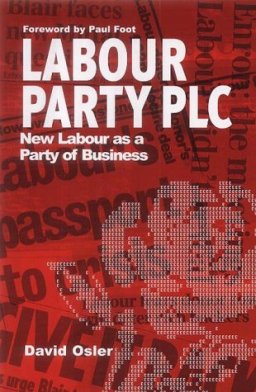
Labour Party PLC David Osler Edinburgh: Mainstream Publishing, £15.99, 2002 Colin Challen MP Having written a history of Conservative Party funding, (1) I had been wondering when somebody would get round to doing a similar job on Labour. However, Labour Party plc is more than a simple history of party financing, it seeks to show … Read more
Lobster Issue 32 (December 1996)
Introduction Despite their reputation for ’empiricism’, British academics have tended to treat political power by means of abstract concepts rather than empirical information about the actions of determinate individuals and groups (e.g. Giddens, 1984, 1985; Scott, 1986). After a brief efflorescence of empirical studies of the so-called ‘Establishment’ in the early 1960s, sociologists in Britain … Read more