Lobster Issue 30 (December 1995)
[…] the parlance of the contemporary government information worker. This was the anonymous call received by George Wigg, the Labour MP, urging him to forget about Vassall the spy and look instead at Profumo. Wigg always claimed it was anonymous but there is good circumstantial evidence he knew the identity of the caller – John […]
Lobster Issue 39 (Summer 2000)
[…] the course of justice, a Prime Minister who engaged in a conspiracy to criminally libel me and a Prime Minister who is using the security services to spy on me, despite the fact that the Crown Prosecution Service immediately found that I had committed no crime when the Blairs attempted to have me prosecuted […]
Lobster Issue 55 (Summer 2008)
[…] Pederson, David Kelly’s mysterious friend, born Mai al-Sadat in Kuwait, who introduced Kelly to the Baha’i faith, a woman both of whose husbands have said is a spy. Pederson shared addresses in the US with Kelly: despite being officially listed only as a US Army master sergeant, she has been able to retain the […]
Lobster Issue 35 (Summer 1998)
[…] libel action, including transcripts and witness statements, and issues examined in the trial – nutrition, animal welfare, environment, employment, global trade, international expansion and capitalism. Interview with spy who infiltrated activist meetings to gather evidence for the ‘McLibel’ trial. Info provided by people who infiltrated London Greenpeace led to the serving of libel writs […]
Lobster Issue 49 (Summer 2005)
[…] communications advisory and agency services, mostly to non-OECD interests and NGOs. Corinne Souza is a former lobbyist, now a freelance writer. Her most recent book is Baghdad’s Spy (Mainstream, 2003). Simon Matthews is a former trade union district secretary with an MA in Modern History. Scott Newton is Senior Lecturer in Modern British and […]
Lobster Issue 35 (Summer 1998)
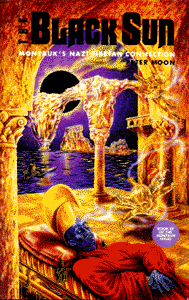
Peter Moon Sky Books £14.70 (including postage in UK) from Counter Productions, PO Box 556, London SE5 ORL I couldn’t resist the title or the blurb: ‘…..covers the German flying saucer programme, the SS mission to Tibet and Hitler’s quest for the Ark of the Covenant and the Holy Grail…..’ But oooooooooh what a … Read more
Lobster Issue 48 (Winter 2004)
[…] proved: That, while I was working for South African Intelligence in London in 1969 (I was officially deported from South Africa in 1966 so that I could spy for BOSS in Britain) the head of BOSS, H. J. van den Bergh, assigned me to infiltrate an extremely furtive underground political group based in South […]