The Open Side of Secrecy: Britain’s Intelligence and Security Committee

Book cover
Lobster Issue 52 (Winter 2006/7) £££

[…] from the government line on Iraq, and he is now at the Brunel Centre. Between them they have much academic and practical knowledge. The authors are essentially conservative defenders of the British security and intelligence system. It isn’t that they aren’t critical; it’s just that they don’t want to, or are unable to, deal […]

Systemic Corruption, Systemic Solutions

Lobster Issue 38 (Winter 1999) £££

[…] voce approval of two merger agreements. The deal was a difficult one: PowerGen wanted to take over of East Midlands, a vertical combination already rejected by the Conservative Government. In return, according to their lobbyist, PowerGen offered to commit to coal contracts to save coal-mining jobs. On June 25, 1998 when DTI Minister Margaret […]

Hess – the Fuhrer’s Disciple

Lobster Issue 25 (1993) £££

[…] covert links between the Nazi leadership and reactionary elements in the British state, located mainly in the City, the landowning aristocracy and the imperialist wing of the Conservative Party. (The activities of those representing a significant part of large-scale industry are not really discussed.) In an interesting ‘Afterword’ Padfield suggests that the Hess flight […]

The getting elected project

Book review
Lobster Issue 56 (Winter 2008/9) £££

[…] reading one sheet of A4. One final point: this reminded me again that among the leading architects of the creation of the current muddled but fundamentally neo- conservative NuLab were a group of ex-CPGB members and one ex-Trot (Mulgan), who in their left incarnations despised the Labour Party, and finally got to help kill […]

Market Killing: What the free market does and what social scientists can do about it

Book cover
Lobster Issue 43 (Summer 2002) £££

[…] primacy. Taking the post-modern route away from the analysis of the real spared the sensitive cultural analyst from those career-threatening conflicts with the line coming from the Conservative governments of the day. If the left was out, post-moderism provided an alternative to embracing the new right, a sideways step. After the authors’ long introductory […]

Brief Notes On The Political Importance Of Secret Societies

Lobster Issue 5 (1984) £££

[…] split into several organisations. The French Grand Orient is politically liberal, and has sharply attacked the Nouvelle Ecole school in its journal Humanisme (March 1981). The more conservative, pro-British Grande Loge Nationale Francais is based in Neilly-sur-Seine, and enjoys the support of fellow mason General Lyman Lemnitzer, who inaugurated its new temple in 1964 […]

Empire’s Workshop

Book cover
Lobster Issue 52 (Winter 2006/7) £££

Greg Grandin New York: Metropolitan books, 2006, $25.00   Reviewing a biography of Harold Laski in 1953,([1]) the historian A. J. P. Taylor remarked on ‘the dilemma of our times’: that ‘no-one who believes in liberty can ever work sincerely with communists, or trust them, yet no-one who has socialism in his bones can ever … Read more

Stalin’s granny, Christopher Andrew and the Cold War

Lobster Issue 38 (Winter 1999) £££

[…] no Soviet grand plan for the invasion of Britain and world domination; and nothing in Mitrokhin’s packet of revelations proves that there was. Even if the ultra- conservative Soviet bureaucracy had wanted to conquer the world, the creaking and sclerotic Soviet system was hardly up to it. The Cold War was never as simple […]

The view from the bridge

Lobster Issue 56 (Winter 2008/9) £££

[…] colleague of Clermont member David Stirling – was curious, as neither prior to this event nor subsequently, did he demonstrate any interest in being leader of the Conservative Party. His candidacy, which allowed Thatcher to look more ‘centrist’ than she actually was, attracted 16 votes and damaged Heath, who lost to Thatcher by 119 […]

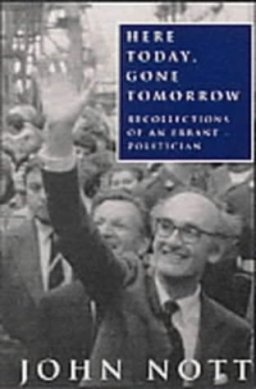
Here Today, Gone Tomorrow: Recollections of an errant politician

Book cover
Lobster Issue 43 (Summer 2002) £££

[…] the food producers. At one point Nott describes himself as ‘a rebel by nature’. Let’s see: from public school to Cambridge University, into the City and the Conservative Party, back to the City and thence, after a brief, eye-opening but unsuccessful spell in the real economy, into retirement as a country gentleman – that […]

Accessibility Toolbar