
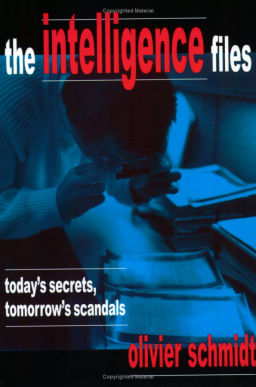
Olivier Schmidt
Atlanta (USA): Clarity Press, 2005, $14.95, p/b
www.bookmasters.com/clarity/currenttitles.htm
Here’s a new name to me, the publisher Clarity; and a familiar one, Olivier Schmidt. In the 1980s Schmidt was producing a very good newsletter in Paris, Intelligence and Parapolitics. This got expensive, professionalised and eventually went on-line for subscribers as Intelligence.(1)
This is a collection of reports and essays from Intelligence, mostly of single events in the parapolitical calendar. For British readers, there are essays on the murder of junior British spook Jonathan Moyles; Dr Bull and the ‘supergun’ and Bull’s murder; framing Libya for Lockerbie; the Chinook crash which killed a large section of the British intelligence and counter-insurgency people in Northern Ireland; the Bloody Sunday inquiry; the Executive Outcomes and Sandline story. There are three American pieces and a couple about other European countries, notably a very interesting account of the so-called ‘Brabant killers’ in Belgium, presented here as part of the covering-up of a wider paedophile ring linked to Belgium’s political elite – killing specific people among the apparently random slaughter – rather than, conventionally, as some weird destabilisation operation. This collection is thus mostly European material. Will this be of any interest to a basically US audience?
The essays are generally very good, intelligent overviews of the events. I would certainly have printed almost all of these essays in Lobster had I been offered them. (A couple are too specialised.) But the most striking piece, quite unlike the others, broader and more historical, is by Kevin Dowling a print and TV journalist. In 1977, having worked in Northern Ireland for the Mirror, Dowling wrote a novel about the province, Interface, which briefly portrayed Colin Wallace and the Information Policy unit in Northern Ireland, which was then still a very sensitive official secret.(2) His career went into the toilet for that. Fast forward twenty years, and with his eye for a story that will get up the right peoples’ noses, Dowling began preparing a TV programme about the politics of nature conservation in Africa. After being lobbied by the Great and the Good, at the last minute Channel 4 pulled the plug on the programme and this essay by Dowling is both the story of that event and some of the script plus further research. At its heart is the presence of intelligence personnel in international nature conservation. I note in this issue (see Obituaries) two former intelligence officers in the World Wildlife Fund. Tracing the history of the conservation movement through the last 100 years, Dowling notes the presence of many more and other members of the ruling elites. What is going on here? Was it merely the (demonstrable) use of conservation in Africa as cover for political games, such as supporting apartheid South Africa? Looking at the list of familiar names – Rothschild, Milner, Astor, Huxley – in the conservation movement’s early days. Dowling suspects there is more to it than that but can’t nail it down.
The question with anthologies of articles is always: do they stand up in book form years after they were written? This one most definitely does.
Notes
1 See http://perso.orange.fr/intelligence-adi/ Subscription price is 325 euros per year for 19 issues, including an annual index.
2 See ‘Information Policy in fiction’ in Lobster 17.