
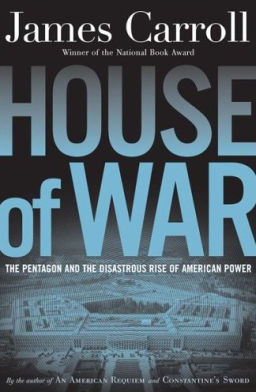
James Carroll
Boston: Houghton Mifflin; 2006, $30 h/b
Juan Bosch was the president of the Dominican Republic from 1963-65. He tried to implement land reforms and was removed from office by a military coup which was then supported by the deployment of 20,000 US troops. In 1967 he published a little book called Pentagonism: a substitute for imperialism (New York: Grove Press, 1969). This is on p.21:
‘Pentagonism nonetheless differs from imperialism in that it does not share its most characteristic feature, military conquest of colonial territories and their subsequent economic exploitation. Pentagonism does not exploit colonies: it exploits its own people…………. to succeed in the exploitation of its own people, pentagonism colonizes the mother country.’
Bosch wrote his little (140 pages) book before computers, when there was little public information and what existed was hard to retrieve. Thirty years later, with computers and an enormous amount of available information, James Carroll has written a huge book elaborating Bosch’s thesis.
Around that core are subsidiary themes. One is a personal memoir. The author’s father was General Carroll, head of the Defence Intelligence Agency in the 1960s, and as a child the author played in the corridors of the Pentagon, turning against American power and militarism during the Vietnam War.
A major theme is a history of the generation and management of ‘threats’ to America to justify the spending on weapons. US ruling elites emerged from WW2 believing that the only way they could avoid a return to depression of the 1930s was by continuing with federal spending. But on what? Military spending had proved to be economically effective and was politically acceptable: warfare state OK, welfare state not OK. So a permanent war footing was required.
He shows that the US view of the Soviets strategically and militarily was completely false. The peaceniks were right: there was no ‘Soviet threat’. The revisionist historians of the Cold War were right; and those within the American political system – the obvious examples being presidents Kennedy and Carter – who tried to slow/stop the nuclear arms race, were right. But Kennedy was killed (if not by the Pentagon, by one of the politicians, LBJ, who fronted for it on Capitol Hill) and Carter retreated when his talk of nuclear disarmament was rubbished at home and in the Kremlin (where there was Soviet arms lobby nearly as powerful as the one in the US). The ‘October Surprise’ conspiracy between the Republican Party and the Iranian regime was merely the final nail in a political coffin which had been carefully constructed by the ‘new cold war’ lobby whose patron was the Pentagon.
Carroll’s father was a victim of the system’s drive to find a threat. In 1969, when head of the DIA, he tried to defend honest intelligence estimates when the military industrial system was trying to create a new threat from the Soviet deployment of Anti-Ballistic Missiles (ABMs). This, said ‘the hawks’, meant a Soviet Union intent on having a ‘first strike’ capability. Not so, said the CIA and DIA. But the system’s needs prevailed: CIA chief Helms went along with it; the author’s father did not and was demoted; and the disputed National Intelligence Estimate was written to produce the required first strike ‘threat’.
There are 650 pages of this, including index and documentation, and it is difficult to convey either its tone or the breadth of its contents. He begins in WW2 with British and American conventional terror bombing of Germany and Japan and works his way right through all the major events in the history of Pentagon: interservice rivalries; manipulation of intelligence and the creation of weapons ‘gaps’; Cuba, Vietnam; the second Cold War, ‘star wars’ and the collapse of the Soviet empire; the Clinton years, Iraq and ‘shock and awe’ – a history of the Pentagon’s role in post-war America. En route there are portraits of the leading figures, both military and political, analyses of doctrinal disputes and accounts of the opposition to the Pentagon and American foreign policy. As a member of ‘the Catholic left’ (his term), he knew the Berrigan brothers, for example; but his brother was part of the FBI squad which was trying to catch them. This is a dense but nicely and simply written multi-layered post-war history of American foreign policy in which his side, the liberal-left, was almost always right but always lost.
This comes covered in praise from American critics on both left (e.g. Howard Zinn) and right (e.g. Gary Wills). The praise is entirely justified. A great book.