
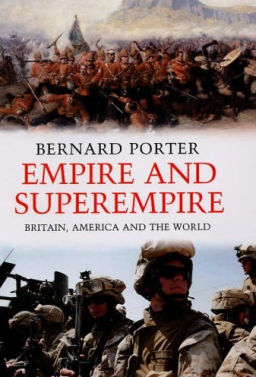
Bernard Porter
London: Yale University Press, 2006, £18.99. h/b
Porter is one of our leading historians of the British empire. He is also a friend of mine. Generally I wouldn’t try and review a friend’s book but this arrived too close to my deadline to find someone else – and someone more competent – to do it.
At the heart of Porter’s portrait of, and comparison between, British and American imperialism is the claim by many American foreign policy wonks, politicians and historians, most succinctly stated recently by Donald Rumsfeld, that America ‘doesn’t do empire’. Ignoring the history and just looking at their current world-wide system of military bases and alliances – Porter cites 702 bases in 130 countries – the statement means one of the following: it is just more of the usual bullshit; is an expression of self-delusion (or national myth, if we were going to be kind); or some very specific sense of ’empire’ is intended. Porter discusses all three and concludes that it’s a mixture of them: lies, self-delusion/myth and – the specific sense of empire – a contrast with 19th century empires, chiefly Britain’s. What Rumsfeld et al really mean is that America doesn’t do empire the way the British did.
Porter canters through a brief version of his view of the British empire: haphazardly acquired, it was not of much interest to the general population in Britain, it was run by skeleton crews and local cooperation, and it wasn’t nearly as exploitative as it is has been portrayed by the Left. He does a similar brisk job on America’s imperial history and after 85 pages states:
‘The aim of this book so far……. has been to show not so much that America was imperialistic, as that she was not much less imperialistic in her history than one other country, Britain, which is generally labelled imperialistic, even when she was not being much more imperialistic than America. (I hope that’s clear.) In other words, they are comparable, whether as empires or not.’
He quotes with approval Patrick O’Brien’s contrast between ‘primacy’ (the British position) and hegemony (America’s): ‘America is the first modern hegemon, imperial or otherwise.’ If American is not an empire in the 19th century sense, it is much, much more than that. We have moved from the Royal Navy’s ambition at the turn of the century to be able to defeat the next two navies combined to the Pentagon’s current doctrine of Full Spectrum Dominance.
In the second half of the book Porter narrows the focus to American and British imperialism after 9-11. These chapters are slightly less satisfactory – less magisterial, perhaps – than the historical overviews that preceded them. It’s partly that current affairs is a moving target. In the case of why the Americans attacked Iraq, for example, our knowledge of the actual decision-making process is growing by the week as the military and intelligence bureaucracies leak in the great game of avoiding the blame for the disaster; and the knowledge that the actual evidence is increasingly available diminishes Porter’s discussion of the possible reasons for the invasion and the slaughter. And it is partly that Porter’s attempt, qua historian, to be fair means taking seriously what would be dismissed by non-historians as obvious baloney. For example, looking at the rationale of ‘spreading democracy’ offered by the neo-cons for the invasion of Iraq, Porter notes:
‘…the haste with which the US, whenever she conquered countries in the post 9-11 period, set about instituting free markets, privatisation and so on there, usually to the benefit of American companies, long before establishing “democracies”, which might have taken another line over these questions. This appeared curious – even anti-democratic – to other kinds of democrats. Surely people should be allowed to have their own economic arrangements, as well as everything else? But it was not, of course, if you assumed that markets and other sorts of freedom were inextricably linked: as in a capitalist-dominated democracy you were likely to.’ (emphasis added)
The italicised section is Porter tipping his hat to one of the recent rationales for American imperialism. But he surely knows that the one thing the Americans will not let the countries they have ‘conquered’ chose is ‘their own economic arrangements’ – and this has nothing to do with beliefs about markets and democracy The point of the conquering is to establish an American-dominated system for the benefit of the American companies. Why else would they bother? But as a historian Porter won’t allow himself to simply make this judgement.
What Porter doesn’t give us is a full-frontal picture – even a sketch – of what either the US hegemon or its British predecessor has done. We just get the occasional glimpse. The British empire did get ugly when the natives got restless: Porter mentions a thousand hangings in Kenya – but not the 20,000 dead. American imperialism is a trail of slaughter starting with the continent’s original inhabitants (and several species). This is implied more than illustrated, taken for granted. He refers to the American conquest of the Philippines and the ‘brutal war’ that ensued; but not the casualties – 200,000 civilians, mostly (it is said) from disease and starvation and some 20,000 Philippine soldiers. Porter refers to US support for nasty dictators but not to the whole infrastructure of death squads and torture (Blowtorch Bob and his ilk) trained and financed by America with which its allies have tried to hold onto power in Central and South America. And so on.
Just as the historical reality, especially in the case of America, has been soft-pedalled, so, too, has the account of the (mostly) American assault on Afghanistan and Iraq. I’m sure Porter would say that, as a historian, he was chiefly concerned with the concepts of empire and imperialism as they apply to Britain and the US and thus in a relatively short analysis (200 pages) he didn’t need – or have room for – the gory details. But don’t we need some of them?
Though not too many for mainstream America, which is the book’s primary audience. The fact that America has been the source of most of the world’s terrorism and the cause of most of the casualties since WW2, simply cannot be baldly presented to a mainstream American audience. It’s not so much that America doesn’t do empire, as Americans – politicians, most academics and the media – don’t do reality. (1) Porter, who has taught at Yale, knows this.
I may sound more critical than I feel. I really enjoyed this. As his review in this issue above shows, Porter writes really well. He presents complex arguments in clear, almost conversational writing; and despite my minor complaints this was an exhilarating read.
Notes
1 A man I know went to a conference at a university in Phoenix, Arizona. He noticed a small news item about the 25,000 homeless in Phoenix and tentatively mentioned this to one of his academic hosts as possibly being evidence that their social system wasn’t working too well. ‘They chose to be homeless’, was the reply.