
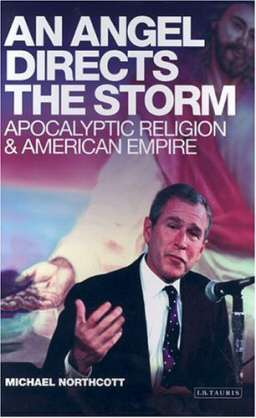
Michael Northcott
London: IB Tauris, 2004, £19.50, h/b
The more you read about modern Americans, the worse it gets. There are millions of them who believe that they are God’s chosen people, that He is directing them to save the whole world, that this is all predicted in the Bible, especially the sinfulness, wars and natural disasters of the present time; but not to worry about any of this, because it’s just the prologue to the ‘last dispensation’: the seventh and last stage of human history foretold in the Book of Revelations, dominated by the Anti-christ ruling through either the UN or the EU (the Book is a bit fuzzy on this); during which, however, the whole of Palestine will be returned to the Israelites, Solomon’s temple will be rebuilt in Jerusalem (just where the Al-Aqsa mosque happens to be now), the Jews will convert to Christianity, and a thing called a ‘Rapture’ will magically pluck the faithful (mostly Americans, one presumes) up to heaven to escape this time of ‘Great Tribulation’, to be plonked down again when the thousand-year Reign of the Saints is inaugurated and all quite soon now. So that’s something to look forward to!
Much follows from this. There’s no point in trying to make things better for people here on earth, for example social reform, environmental protection because that would take the edge off the Tribulation, and so slow things down. Peace between Israel and Palestine ditto. Internationalism is just a cunning disguise for the reign of the Prince of Darkness. American imperialism is the agency of God’s salvation. George W. Bush is the Angel of the Lord. And so on. It sounds crazy. Dan Brown (The Da Vinci Code) could never have got away with it.
Northcott nonetheless believes that it is a ‘powerful cultural and religious force in modern America’. Several of those around George W. Bush, for example, are premillennial dispensationalists (the theological term for it), as may be the President himself. (It would be unwise for him to come out with it too plainly, for fear of scaring off rational Republicans.) A poll of Americans in 1996 showed that 40% described themselves as evangelical Christians, and a quarter believed they were living in the ‘end times’. That is a huge number: the equivalent of half of those who vote in Presidential elections. Premillennialism has also, Northcott thinks, influenced American religion more generally, making it much more Manichaean (the ‘good/evil’ thing), antisocial, crusading and war-like than many other Christian traditions; and tying it with American patriotism in a way that would be impossible almost anywhere else in the modern world. In fact, argues Northcott, evangelical Christianity has become the religion and so the tool of American imperialism, much as the earlier form of it was captured by Roman imperialism to become its religion in the third century AD.
Northcott is a Christian theologian, who is writing here mainly for other Christians, presumably, in order to show them what ‘a tragic deformation of true Christianity’ this is. Otherwise, of course, Christianity itself would stand indicted. All this seems generally convincing to me, as a lapsed (English) Methodist, who remembers Christianity as by and large a rather gentle religion, totally unrecognisable from the modern American evangelical version; and hopefully may convince one or two evangelicals, too. For the rest of us, however, the value of the book lies in its description of this freakish theology, and its analysis of its historical and more recent American roots. Some of these are unexpected: Northcott partly blames the famous American constitutional separation of church and state, for example, for allowing patriotism to be erected in place of Christianity as a ‘state’ religion in schools; others are more predictable: the Puritan immigrants, and all that. All this is fascinating.
The book is also worth reading as a powerful moral indictment of American capitalism and foreign policy more generally. On ‘9/11’ it even hints at a conspiracy. (The administration may have known it was coming but let it happen to give them the excuse to attack Iraq. It was all part of the Great Tribulation, after all.) So you can skip the theology, and still learn a lot.
The influence of this kind of religion in America seems to have taken many of us in Europe by surprise, because of America’s apparent modernity in other regards. It was a mediaeval historian friend of mine (an expert on heresies which seem very close to this one) who once described the USA to me as ‘a mediaeval society with modern technology’. Of course these fantastic theologies are exploited by others capitalists and so on for their own cynical ends; but that does not gainsay the visceral hold that religion has on these people. If modern and rational Americans don’t take this on board, and do something about it, we may be in for even more pain than at present. ‘The end times’ could even become a self-fulfilling prophecy.