
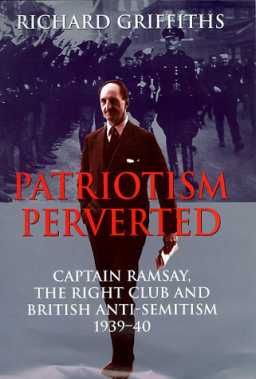
Richard Griffiths
Constable, 1998.
Ten years ago this would have been a publishing sensation. Griffiths, the great expert on the British right and their fellow travellers, has found the membership list of the Right Club – a group active in 1939/1940 seeking to coordinate the work of all the patriotic societies. This book is his description of their activities and a stab at guessing the identity of a British collaborationist government. But time has, apparently, marched on. So far there have been few reviews, and one of these (by M.R.D. Foot in The Times) snootily accuses Griffiths of revisionist history writing.
Evidence now shows that a bigger than usually imagined section of MPs and Peers were willing to strike a deal with the Nazis in 1939/1940.(1) Griffiths homes in on two periods, from the collapse of Czechoslovakia to the invasion of Poland (March -September 1939) and, especially, from the start of war to Dunkirk (September 1939 – June 1940). In the first segment a sizeable number of politicians and public figures continued to advocate and work for a deal with Nazi Germany. After the outbreak of war this number diminished but continued to include a surprisingly large number of individuals.
Ramsay formed the Right Club as an umbrella group in May 1939. Its membership included 12 MP’s (2) as well as the usual associated figures of the time, William Joyce, A. K. Chesterton, Arnold Leese, Admiral Domville, the Duke of Bedford and others.(3) Mosley remained a bit cagey – probably wanting to stay top dog. Griffiths goes into great detail on the motives and background of many of these but concludes they had little effect on the course of events, possibly because their great hope (a European crusade against Bolshevism) was dashed by the Nazi-Soviet Pact (August 1939).
The singular Mr Stokes
Once the war with Poland was over, though, Ramsay and his friends openly strove to reach a deal with Hitler. Nor were they alone. Griffiths notes the effort put into this by Richard Stokes – Labour MP for Ipswich.(4) The Soviet attack on Finland (November 30th 1939) opened the possibility of converting the war from an anti-Hitler crusade into an anti-Stalin crusade. This was congenial to many. After a solemn (though ineffectual) House of Lords debate on peace terms in December 1939, Ramsay and his supporters had their greatest (and only) success on January 5th 1940 when they succeeded in dislodging Hore-Belisha, the Minister for War (and a Jew), who had advocated an aggressive campaign against Germany. A week later Stokes was in the Vatican earnestly discussing how to bring peace to Europe and get on with the real task of civilisation – a common struggle against Communism.
Griffiths fails to explore who promoted British support for Finland against Soviet Russia.(5) By January 26th 1940 there was a Committee to Aid Finland (funded by Lord Nuffield);(6) with a panel, including one Admiral Beamish,(7) that interviewed volunteers for a British Expeditionary Force for that country. In February 1940 Stokes was in Ankara negotiating with von Papen, the German Ambassador to Turkey.(8)
This is fresh information and something of a bombshell.
Although the first detachment of British volunteers reached Finland on March 11th 1940, the Finns capitulated on March 13th and the volunteers saw no action.
This did not discourage either Ramsay or Stokes from fresh efforts. Ramsay concentrated Right Club activities on espionage, assisted by Anna Wolkoff, Tyler Kent and a small social circle.(9) In March 1940 Griffiths tells us that Wolkoff leaked the British/French plans to seize Narvik to William Joyce via the Italian Embassy in London.
This is bombshell no. 2.(10)
By the end of March Stokes had the support of Lord Beaverbrook and the I.L.P. for his peace plans…… which he continued to push until July and August 1940.(11) It all came to nothing. Following the debacle in Norway (which Wolkoff aimed to create) Churchill became Prime Minister. Ramsay, Mosley and most of their followers were arrested and interned from May 23rd 1940 onward.
How do we deal with this and what judgement should we make about the activities of Ramsay and these characters? Despite fresh evidence (from the membership list) Griffiths, ultimately, comes to the same conclusion as Herbert Morrison in 1941 that Ramsay was an unstable conspiracy theorist, many of his followers were cranks, and many of those on the Right Club membership list may not even have known they were on it.
The problem with this analysis is that any MP or public figure questioned by MI5 and the Special Branch in 1940 (facing potential treason charges which carried the death penalty) about their presence in Ramsay’s address book would have indicated surprise, wouldn’t they? On the face of it the Right Club list seems reasonable. It has a dozen or so MPs. There are some Peers, some cranks and misfits, and some maverick public figures (Mosley). If Quisling, Degrelle, Pavelic and other traitors ever kept similar lists prior to forming collaborationist governments they presumably looked like this. So the list is probably a solid guide to those who would have been prepared to consider serving a collaborationist government in Britain in 1940 or later. It is also more credible than the list carried by Hess when he landed in May 1941, and much bandied about since.(12)
Also: if the Right Club really were nothing more than a bunch of cranks why are the Ramsay files still blocked at both the PRO and the US Dept of State?(13) Griffiths, despite his conclusions, produces evidence to point to a considerable effort to get out of a war with Germany by many MPs, and not just Tory ones, even after September 1939. He also shows that several key military reversals (Norway 1940 and Malaya 1941) may have been due to treachery.(14)
Nor were the Right Club gang entirely political losers even if after 1945 Ramsay crept away from public life, spending his time and money on funding Britons Publishing with Arnold Leese. Others who followed him remained politically active. Colonel Kerr (as Lord Teviot) organised the merger of the Liberal National Party with the Conservatives in 1947. Major Edmondson was Chairman of the Carlton Club until 1956. Lt. Commander Agnew remained MP for South Worcs until 1966 and Lord Lymington/the Earl of Portsmouth was a key figure in the white settlers in Kenya throughout the 1950s. Later still the Marquess of Graham could be found in the Rhodesia Front.
The great success though, was Richard Stokes. After advocating the discontinuance of war crimes trials in 1947/1948 (specifically of German generals for atrocities committed in the Russian campaign),(15) he rose steadily. The launch of NATO and Attlee’s dumping of Bevan brought him into the cabinet in 1950/ 1951 serving as Lord Privy Seal, Minister of Supply and Minister of Materials.
One conclusion to draw from this (despite the views of M.R.D.Foot) in the light of the collapse of Soviet Communism and the growth of nationalism in Europe is that a revision of British history, and the objectives of the British establishment in the last 50-60 years is overdue. Maybe those who sought an anti-Bolshevik crusade to save civilisation (called the Cold War when it took place after 1945) were not as ineffectual or cranky as one would have supposed even a decade ago. A sobering thought.
Notes
- The shabby era of appeasement and the Phoney War remains a taboo subject in many respects – even at the level of popular fiction. Len Deighton made his name with the Harry Palmer spy thrillers, three of which, The Ipcress File (1962), Funeral in Berlin (1964) and Billion Dollar Brain (1965), were immediately filmed. The other book in the series, Horse under Water (1963), about a Tory MP trying to stop the release of his WWII business dealings with the Nazis did not, apparently, interest film producers.
- Lt. Commander Agnew, Captain Stourton, Sir Ernest Bennett, Colonel Kerr, Lord Crichton Stuart, John M’Kie, Colonel Mitchell, Provost Hunter, Sir Samuel Chapman, Major Edmondson, Mavis Tate and Ramsay.
- Joyce and Chesterton were ex-BUF. Chesterton went on to lead the National Front 1967-1970. Leese (a fanatical anti-semite) looked after the UK affairs of Henry Hamilton Beamish, who lived in Rhodesia. Beamish had stood unsuccessfully for Parliament in 1918, founded the Britons Society and spoke at public meetings with Hitler, in Munich, in 1923. Domville, an ex-Director of Naval Intelligence, ran The Link which had 4300 members in June 1939 including two cousins of Neville Chamberlain who were still active in local government in Birmingham. The Duke of Bedford was a Social Credit enthusiast who funded the British Peace Party (General Secretary John Beckett, a former Labour MP and ex-BUF). The rogues’ gallery gets bigger when the hangers-on are considered . . . Lady Douglas Hamilton (wife of the man Hess flew to meet in 1941), Reginald Dorman-Smith, Governor of Burma when the Japanese invaded in 1941, Sir Jocelyn Lucas (MP for Portsmouth South and involved with Beckett and Joyce in the National Socialist League), Lady Pearson, the sister of Henry Page Croft who had led the National Party 1917-1922, and the Marquess of Graham, another Rhodesia resident.
- Richard Stokes 1897-1957, Labour MP for Ipswich 1938-1957. He was a staunch Catholic and took the Vatican line on most major issues.
- This is hardly surprising as the period remains poorly documented. The only major work, The Volunteers: The Full Story of the British Volunteers in Finland 1939/1941, was privately published by the author, Justin Brooke in 1990.
- Nuffield funded Mosley 1931-1935.
- Beamish was Tory MP for Lewes 1924-1931 and 1936-1945. He was the brother of Henry Hamilton Beamish. See note 3 above.
- Mark Aarons and John Loftus, Ratlines – How the Vatican Nazi Networks Betrayed Western Intelligence to the Soviets (1991) say on p. 164 that the Foreign Office approved armistice negotiations via the Vatican in October 1939 and that serious talks started on January 12th 1940. Von Papen was a Catholic/Conservative German politician who had served as Chancellor June-November 1932 and later advised Hindenburg to appoint Hitler.
- Wolkoff was a Russian exile, Kent a cipher clerk at the US London embassy who leaked to Ramsay all the private material between Roosevelt and Churchill 1939/1940. Originally thought to be a Nazi spy, after 1945 the CIA considered him to have been a Soviet agent all along (not a contradiction during the Nazi-Soviet Pact).
- Aarons and Loftus (op. cit.) also say, p. 212, that, contemporaneously with this, whilst attached to a military mission in Belgium, in early 1940, the Duke of Windsor/Edward VIII discussed British and French military preparations in Flanders with a German emissary (unnamed).
- Beaverbrook wanted no European commitments: he ran the British Empire Party/Empire Free Trade Crusade 1931/1935, and spoke against both US loans and Marshall Aid in 1946/1947. The I.L.P. were a pacifist/Trotskyist group of 4 MPs 1935/1945.
- See Philip Knightley, ‘Surely its time for the truth’ (Independent on Sunday 24 August 1997). Hess’s list included Sir Alec Douglas-Home, R.A. Butler and Lord Halifax.
- John Costello said (The Guardian 21 May 1990) that he saw the files in the US in 1981 but they had been removed in 1982 and their place was marked by a card stating GBR/INTELL – i.e removed at the request of the British government. This was the period during which the SDP was launched and the Falklands War fought.
- Griffiths says that Lord Sempill (a Right Club member) was retired from the Royal Navy in 1941 under suspicion of leaking documents to the Japanese. Peter Elphick in Singapore: the Pregnable Fortress, a study in Deception, Discord and Desertion (1995) pp. 107-111 revealed similar stories. Elphick’s is the first study of the Far East debacle of 1941/1942 to be produced after the release of previously withheld documents.
- See Tom Bower’s Blind Eye to Murder – Britain, America and the Purging of Nazi Germany – A Pledge Betrayed (1981) p. 283. Bower calls Stokes extreme right.