
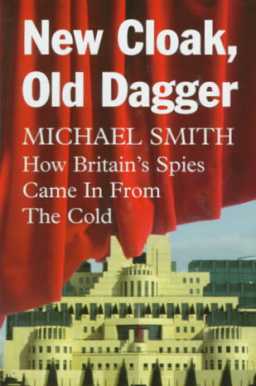
Michael Smith
Gollancz, London,1996, £20
This is a curious and rather pointless book. In short chapters Smith attempts potted histories of MI5, SIS, signals and military intelligence. These are quite well done, but covering half a century in 20 pages, say, the chapters are barely more than sketches. (The Information Research Department gets a page!) Every once in a while we get a detailed chunk: but who needs another version of the Cambridge spies (Philby et al) and Blake? There are some striking omissions. On the history of decolonisation, not a word on Kenya and Nigeria; and the barest outlines on Rhodesia, Cyprus and Malaya. Reading this book you would never know that the British state was engaged in continuous guerrilla warfare in its colonies after the war. On the revelations in the late 1980s of campaigns against the Wilson government we get nothing but repeated and unsubstantiated rubbishing of the late Peter Wright (pp. 17, 60, 65).
There are some new fragments. He has interviewed a couple of the people who took part in the training of stay-behind groups in the cold war – the Gladio Network; and on Ireland there are some new details about the 1972 talks with the Provos and the role of the SIS officer, Frank Steele, the ‘large, pipe-smoking Arabist, a veteran of Suez and the Sudan’, so described but not named in Anthony Verrier’s Through the Looking Glass.(1) Smith quotes Steele as saying to the Provo leaders at the talks: ‘I hope you’re not going to start your bloody stupid campaign of violence again. If the IRA really wanted a united Ireland, it was wasting its time shooting British soldiers and bombing Northern Ireland into an industrial and social slum,’ he said. ‘It would be better employed persuading the Protestants that they could have a good life in some sort of union with the South.’ (pp. 223/4)
But Smith’s account of the war in Ireland omits almost all the bad things the British state did there in the 1970s. There is no reference to Colin Wallace, dirty tricks, the Information Policy Unit, the Ulster Workers Council strike, and Fred Holroyd; and almost nothing on loyalist collaboration with the intelligence services and the Army. The disastrous early attempts at covert operations by the Army and SIS are glossed over. The role of the MRF is almost completely missing, and in the main text the SIS use of the Littlejohn brothers to rob banks and attempt to penetrate the IRA is dismissed in the line, ‘the Littlejohn fiasco (in which a Dublin bank was allegedly robbed on behalf of MI6).’ (p. 224)
In a long footnote, however, no. 45 on p. 311, Smith flails around trying to get round the embarrassment of Littlejohn.
First he offers an unsourced – and probably fictitious – comment that ‘even the IRA admitted that much of what they [the Littlejohns] said was “pure cock and bull.”‘
Second, acknowledging ‘the fact that subsequent court proceedings were held in camera “for reasons of national security” seems to confirm they had some involvement with the British’, he adds, ‘although not necessarily with MI6. Senior intelligence sources said that even if the Littlejohns had been MI6 agents – and they were unable to say if they were – their brief would not have extended to robbery. “The rules of engagement, the terms under which one operates, are pretty clear, pretty tight,” one said.’ (Emphasis added.)
This is bullshit of a high order. The trial was held in camera because the whole operation, and the Littlejohns’ handlers, were blown. It is truly bizarre to try and deny it at this stage in the proceedings. The Littlejohn fiasco seems to have taught SIS nothing, for two years later the SIS officer then in charge of Northern Ireland, Craig Smellie, asked Fred Holroyd if he fancied robbing a bank.(2)
However there is a rather interesting section on pp. 226 and 227 about the undercover army units in Northern Ireland.
‘Within a year [of the uncovering of the Four Square Laundry operation in October 1972] the Army was mounting new covert operations. This time they were developed with the aid of the SAS….the soldiers involved were recruited from a variety of units and originally operated under cover as Royal Engineers. A variety of cover-names followed – most famously 14 Int. – but within the limited circle of soldiers familiar with the unit’s activities it became known as ‘the Det’…..the SAS…..was heavily involved in the Det in the early stages’.
This whole 14th Int. saga is now very confused. It began in the James Adams, Morgan and Bambridge Ambush (Pan 1988); a slightly different version appeared in Mark Urban’s Big Boys’ Rules (Faber and Faber 1992); Smith has now offered a third. In an interview I heard on Radio 5, the former British soldier, Sarah Ford, in the course of plugging her new book One Up (Harper Collins, 1997), about her time undercover in Northern Ireland, referred to 14th Intelligence as ‘a cover story’ and then to ’14th Int. SAS’; and an article in the Daily Telegraph 17 March 1997 refers to ‘a small undercover SAS team stationed at Castledillon in the mid 1970s’. One interpretation of these shifting accounts, all sourced directly or indirectly back to the MOD, is that the Ministry is inching up on the truth – i.e. Fred Holroyd’s position – but doing it slowly in the hope that no-one will notice.
The material on the post Cold War era suggested by the book’s subtitle is the best section – that is, it contains the most material which hasn’t already been done to death. It follows the current government line of seeking to justify the continued existence of the intelligence services by reference to economic intelligence, the so-called ‘war on drugs’ (which was lost about 20 years ago, even if it was worth fighting in the first place) and organised crime. With a straight face Smith assures us that organised crime is a threat to Britain’s security. But 15 years ago, so, apparently, was CND…..
Smith is a Daily Telegraph reporter, and, like that paper, his book is well written and generally well documented. But like that paper he is far too willing to accept the state’s agenda, presenting its current rationales and steering the reader away from the embarrassing stuff.
Notes
- Jonathan Cape, 1983, p. 302
- Fred Holroyd, War Without Honour, (Medium Publishing, 1989), p. 88.