
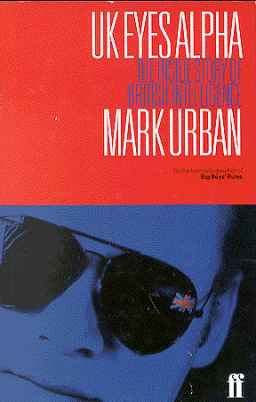
Mark Urban
Faber and Faber
London 1996 £16.99
The first sentence of Urban’s conclusion to this very interesting and rather important book is: ‘More than anything else, British intelligence is a system for repackaging information gathered by the USA.’ He might have added, ‘information gathered in large part at US bases in Britain’.
Urban has persuaded a surprising number of the Whitehall elite to speak on the record – and many more off it – in a survey of British policy in the last decade or so through the eyes of the intelligence and security services. Centrally this an account of the increasingly feeble British state clinging to the Americans, willing to pay any humiliating military or diplomatic price to remain the school bully’s best friend. Wear the figleaf of ‘international support’ for the US while the rest of the EU snigger behind their cocktails? Yes, sir. Send Tornado pilots to their death in Iraq on suicidal low-level bombing missions? Yes sir, if that’s all we have to offer (especially, as Urban tells us, when large procurement programs hang on the missions).
In the unattributed words of ‘one of those considering the information’, ‘In the intelligence world the Americans have all the cards. Without them, we’d be little better than Belgium.’ To the former head of the US National Security Agency, Britain was as useful to the US as Australia – they both had large US listening stations on them, Pine Gap in Australia and Cheltenham and Menwith Hill in the UK.
The truly odd thing is that this geo-political grovelling for intelligence crumbs didn’t do much good. Urban’s book is a long catalogue of failures. For all the global surveillance of the National Security Agency and its minor allies in Britain, Australia and New Zealand, British (that is US) intelligence were completely taken by surprise by the collapse of the Soviet empire, unable to penetrate Soviet diplomatic traffic, unable to find let alone count mobile Soviet nukes in East Germany; unable to produce useful intelligence in Yugoslavia when it disintegrated, and unable to predict the Iraqi invasion of Kuwait. Joint Intelligence Committee reports on Iraq are described by former Foreign Office Iraqi desk officer Mark Higson as ‘completely useless – you’d get stuff you’d actually read in yesterday’s Evening Standard.’
Britain’s senior diplomats and politicians apparently never took much notice of intelligence reports anyway. David Mellor, some time junior Foreign Office minister, found nothing of value in them. Incredibly, British intelligence did not know whether South Africa had nuclear weapons. (Though readers of the left press, or the book by Barbara Rogers and Zdenek Cervanka, The Nuclear Axis, Friedman, 1978, did.) Anglo-American intelligence wildly under-estimated the number of Soviet nukes and grossly over-estimated the tonnage of Soviet chemical and biological weapons. Urban comes close to inviting the reader to conclude the billion or so a year this country spends on the spooks is money wasted.
For much of the past twenty years none of this mattered much, for the intelligence services had one major fan – Mrs Thatcher. If no-one else took their reports seriously, she did, taking them home in the evenings; and under her the spooks’ budgets more than doubled. This isn’t so surprising. Mrs Thatcher’s rise was managed by Airey Neave, whose ‘intelligence connections’ even she acknowledges in the first volume of her memoirs; and when she became leader of the Tory Party she was given tutorials by a group of retired spooks, which included Brian Crozier. Little wonder that she once told an interviewer that she’d read Frederick Forsyth’s execrable The Fourth Protocol twice. Forsyth’s novel, you may recall, describes a Kinnock-led Labour Party getting into office only to suffer an internal coup from the left, controlled by the KGB. The reality, however, was that from KGB defectors Gordievsky and Kuzichkin – notably the latter, who disappeared without trace – our spooks learned that the KGB and GRU (Soviet military intelligence) were generally useless, their personnel chiefly concerned with enjoying themselves overseas, keeping their heads down and ripping-off what they could. Not for them the enthusiastic pursuit of intelligence coups – as would-be ideologically defector Michael Bettanay discovered when his overtures to the Soviet embassy in London were spurned by the cautious comrade Guk. ‘It was not in the institutional interests of British intelligence to tell ministers or officials what they knew about the inefficiency of the KGB and GRU’, remarks Urban. And vice versa, presumably.
But MI5 helped smash the miners and MI6 ran Gordievsky who helped explain Gorbachev, and so MI5 and MI6 got their bids for new buildings through the system before oil revenues began drying up and the Tories’ public sector deficit ran out of control in the 1990s. In the struggle for shrinking state resources in the last few years MI5 has come out on top, replacing the Soviet ‘threat’ with the terrorist ‘threat’, and actually expanding its personnel, while MI6 and GCHQ are tightening (pretty generous) belts. Let’s hope the IRA, the animal rights movement, Green Anarchist and the anti-roads campaigners are suitably flattered to be the equivalent of the espionage services of a super-power!
For all the welcome candour of some of his interviewees, there are still corns that Urban won’t tread on. The whole ‘Wilson plots’ revelations of 1986-89, thousands of column inches, the major cause of our present increased understanding of the British spooks, is evaded with a brief reference to the Peter Wright interview with John Ware in which Wright recanted(1) – as if that’s all there was to it – and somehow he manages not to mention that the reason there were not enough Challenger spare parts to maintain operational tank units in Germany and Iraq at the time of Desert Storm had something to do with the cost of Trident/Polaris swallowing up the available military budgets. Nonetheless, this a considerable step forward in our understanding – and demystification – of Whitehall’s secret warriors.
Notes
1 John Ware has his uses, doesn’t he? Rubbishing Wallace and getting Wright to admit it was all nonsense. Nice one, John.