
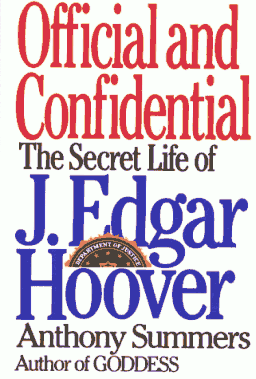
Anthony Summers
Gollancz, London, £18.99
Summers and his team of researchers have proved, beyond a reasonable doubt, that Hoover was gay and that he had been bought off and blackmailed by the Mob into ignoring organised crime. (I am less convinced by the evidence supporting the secondary allegations that Hoover was a transvestite.) Hoover, in turn, used his agency to collect the dirt on America’s politicians and blackmail them into increasing his budget and allowing him to make himself wealthy. Post-war American domestic politics? In the beginning, the Mob fixed Hoover and Hoover fixed the politicians. Summers’ book conveys a very powerful sense of just how intimate the Hoover-Mob connection was and how far the Mob had actually gone towards fixing the political and federal law enforcement system. Not that the Mob was trying to ‘take over’ America, but simply that it thought it had paid off and/or blackmailed enough people to ensure immunity from serious investigation.
The fact that the Mob had the FBI in its pocket until the sixties and the arrival of the Kennedys, seems to add further weight to the notion that the Mob shot JFK — essentially to turn off Bobby Kennedy’s ‘war on crime’. Except…. the problem with the Kennedy story is distinguishing between myth and reality. Was there actually such a ‘war’? Given old Joe Kennedy’s relationship with various Mob figures, I have often found this difficult to believe. I was very taken with a snippet on how Robert Kennedy conducted such investigations into organised crime while still a young law graduate working for Congress, before John became President in 1960. In his Robert E. Kennedy (Trident, NY 1968) Kennedy-phobe Victor Lasky quotes a journalist called Roland May of the York [Pennsylvania] Gazette and Daily:
‘The forays of the Kennedy sleuths…. into St. Louis, Chicago, Gary, Philadelphia, Manhattan, Brooklyn, the Bronx and Miami were followed by a remarkable swing of Democratic politicians in the same areas to the Kennedy Presidential cause. And unions involved did the same.’ (p. 119)
It is tempting to think that something similar was going on during the Kennedy Presidency, that the ‘war’ was simply the Kennedys using the Justice Department to attack those bits of organised crime which didn’t support the Kennedy wing of the Democratic Party. Indeed, some of the Mob did think that the Kennedy ‘war on crime’ was just politics. In the recent All American Mafiosi: the Johnny Rosselli Story, (Doubleday, London 1991) authors Charles Rappleye and Ed Becker recount how in ‘certain select circles…. some of the very gangsters targeted in the war on crime believed at first that it was a sham, and then that they could handle it through surreptitious “diplomacy”. Sam Giancana and John Rosselli…. were the last to realize that the Kennedy campaign against them was for real.’ (pp. 203 and 4) (It was this ‘diplomacy’, presumably, in which Judith Campbell Exner was engaged in her role as the go-between for Giancana and JFK.)
But the evidence — mostly from wiretaps — is clear that most of the Mob certainly didn’t see it like that. They saw themselves under serious attack by Bobby.
Of course it wasn’t anything resembling a ‘war’ at all. Even a very Kennedy-phile account such as that in chapter two of Victor Navasky’s Kennedy Justice (Atheneum, New York, 1971) makes it clear that ‘campaign’ or ‘drive’ is certainly a better term than ‘war’ which suggests a scale and commitment which is inappropriate. (As far as I am aware the Kennedy campaign against the Mob has yet to be critically re-examined. Where did the Kennedy team work? Who were their targets? How were the targets chosen? Is there a pattern — geographical? political? — in the group’s activities?)
The problem with the ‘Mafia did it’ thesis is that it only survives intact if a good deal of evidence, both about Oswald’s history and the post-assassination cover-up, is ignored. There is enough evidence to make decent cases for both the Mob-did-it and the CIA-did-it hypotheses; and there is now quite a bit of evidence on the CIA-Mob relationship going back to WW2 and the original contacts with OSS. We might now reasonably expect a plausible hypothesis on the JFK assassination to include a role for both organisations. A crude Mob hit (with Ruby tidying-up the loose ends on the ground), followed by a sophisticated CIA-directed cover-up, perhaps?
In Lobster 23 I hypothesized, semi-seriously, that the straw which finally triggered the CIA to remove JFK was his support for the rapprochement between the Christian Democrats and the Italian Socialist Party — the so-called apertura a sinistra in Italy. Evidence of how seriously the NATO political establishment took this idea is suggested by the fact that the apertura and its ramifications was the lead item in ‘Notes of the Month’ — the editorial — in the Royal Institute for International Affairs The World Today (March 1962, pp. 89-91).