In 1976 Mary Ferrell discovered a curious CIA document, a telegram that had been sent from the Agency office in London to headquarters in Langley on 23 November 1963, the day after JFK was assassinated. The telegram reads as follows (blacked-out(1) matter shown by brackets, with suppositions in italic):
- [Paragraph deleted in its entirety]
- EXPRESSIONS OF SORROW AND SYMPATHY RECEIVED FROM TOP COMMAND [Probably British Government] AS WELL AS WORKING LEVEL. EFFECT IN U.K. IS ONE OF PROFOUND SHOCK AND PUBLIC REACTION HERE SIMILAR TO DEATH OF FRANKLIN ROOSEVELT.
- DUE TO BACKGROUND MAN CHARGED WITH ASSASSINATION, [MI5?] REPORTED MORNING 23 NOV FOLLOWING DUE SOME SIMILAR PHONE CALLS OF STRANGELY COINCIDENTAL NATURE PERSONS RECEIVED IN THIS COUNTRY OVER PAST YEAR, PARTICULARLY IN CONNECTION WITH DR WARD CASE. [MI5?] REPORTED THAT AT 1805GMT 22 NOV AN ANONYMOUS CALL WAS MADE IN CAMBRIDGE, ENGLAND TO THE SENIOR REPORTER OF THE CAMBRIDGE NEWS RPT CAMBRIDGE NEWS. THE CALLER SAID ONLY THAT THE REPORTER SHOULD CALL THE AMERICAN EMBASSY IN LONDON FOR SOME BIG NEWS AND THEN RANG OFF. LAST NIGHT AFTER WORD OF THE PRESIDENT’S DEATH WAS RECEIVED THE REPORTER INFORMED THE CAMBRIDGE POLICE OF THE ABOVE CALL AND THE POLICE INFORMED [Special Branch or MI5]. IMPORTANT THING IS THAT CALL WAS MADE ACCORDING TO [British] CALCULATIONS ABOUT TWENTY FIVE MINUTES BEFORE PRESIDENT WAS SHOT. CAMBRIDGE REPORTER HAD NEVER RECEIVED CALL OF THIS KIND BEFORE AND [British] SAY HE IS KNOWN [?] TO THEM AS SOUND AND LOYAL PERSON WITH NO SECURITY RECORD. [British] WANTED ABOVE REPORTED PARTICULARLY IN VIEW REPORTED SOVIET BACKGROUND OSWALD. DEPENDING ON CIRCUMSTANCES, HQS MAY WISH PASS ABOVE TO [?] AS [British] COULD NOT REACH [FBI?] REP THIS MORNING. [British] STAND READY ASSIST IN ANY WAY POSSIBLE ON INVESTIGATIONS HERE.
What were the ‘similar phone calls of strangely coincidental nature persons received in this country over past year, particularly in connection with Dr Ward case’? We know of the call in the Stephen Ward/John Profumo case that kick-started its public exposure,(2) but were there others, and what were the calls not connected with that scandal about? Of these we know nothing.
I did some desultory research into the Cambridge call back around 1980 and spoke to a number of journalists who were working on the Cambridge Evening News in the early 1960s. None of them had ever heard of the call. It is possible that the reporter kept the call under his hat and just phoned the police once news of the assassination came through, but is this likely? Surely he would have mentioned it to his colleagues? After all, it would have made a pretty interesting and important lead story at the very least. Is the description of the journalist as ‘sound and loyal’ telling us there was more than a passing connection between him and the security services, that he was known to them? The phrasing suggests to me more than a quick rifle through the files. ‘Sound’ is a word that suggests first hand knowledge. Something is going on here, but what I don’t know.
Newspapers frequently receive anonymous tip-offs and they are always specific. There was nothing specific about this call. According to the telegram ‘the caller said only that the reporter should call the American Embassy in London for some big news’ and that was all. The caller didn’t say what the big news was about, but for the American Embassy to be a source it must be something of national importance. It hardly sounds like a hoax call or a random phone psycho who just coincidentally called on the day the president got shot (though the possibility cannot be ruled out entirely).
How do we know the caller was referring to the assassination? We don’t. It is difficult, however, not to conclude it was the assassination the caller had in mind, particularly when one considers the timing of the call – twenty-five minutes before the shooting. Could there have been another event on that day intended? I checked in that vast repository of ‘big news,’ Chronicle of the 20th Century (London: Longman/Chronicle, 1988) and several other sources to see if there was any US news event sufficiently important for the Embassy to concern itself with – there wasn’t, neither on 22 November nor through to the end of the month. The only other news getting important coverage was the death of Aldous Huxley in Los Angeles, also on 22 November, but this is hardly something consular officials would be concerned about.
The CIA telegram first received widespread publicity when it was reproduced in a book written by Michael Eddowes and published in 1977.(3) If the call did actually occur, then who made it? Eddowes frequently told me in conversation that it was Dr Stephen Ward who made the call.
What evidence do you have, Michael?
None, but I know it was him!
A.k.a Bowen
Later, Eddowes became convinced it had been made by that strange ‘itinerant preacher,’ Albert Osborne (a.k.a. John Howard Bowen), a suggestion that was based on Osborne once giving his address as The Old Folks’ Home, Grimsby (some eighty miles north of Cambridge) and the fact that he had travelled to England for the first time in forty years to visit his relatives in 1963, in the three weeks just before and after the assassination.(4) Chapman Pincher subsequently stated the call was made by Victor Louis, the London Evening Standard’s Moscow correspondent; but the only evidence adduced was that Louis was a communist and therefore, one supposes, capable of anything.(5)
Earlier this year my annotated examination of the JFK assassination paperwork generated by the FBI’s London office was published in the States.(6) I had a file that allegedly contained all of the Bureau’s London documents. However, I did add in the Afterword that I suspected this was not the case and there may indeed be errant documents that had escaped disclosure, papers that were NOT TO BE FILED.
Another Cambridge document
In August of this year I received from the National Archives at College Park an FBI London document that I hadn’t seen before – reproduced here in facsimile. It had arrived at the Archives in the files of the House Select Committee and not directly from the FBI itself. This, I believe, is the first document to surface referring to the Cambridge call aside from Mary Ferrell’s discovery. A good three-quarters of it is blacked-out and it would be interesting to know just what is being hidden and why. I am trying for full disclosure under the FOI legislation and also through the Assassination Records Review Board. I also have some other inquiries in hand and I hope to return to the subject in a future issue of Lobster.
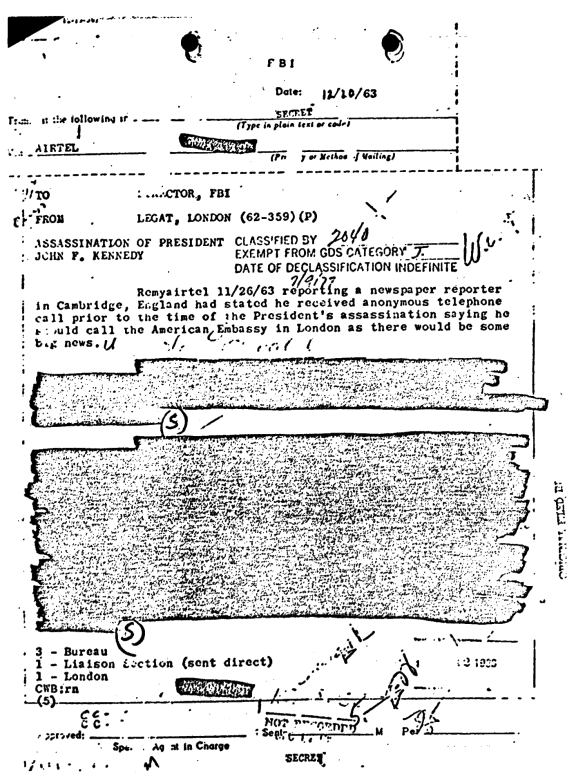
TO: FBI. FROM: LEGAT, LONDON. ASSASSINATION OF PRESIDENT JOHN F. KENNEDY. CLASSIFIED BY 2040. EXEMPT FROM GDS CATEGORY J. DATE OF DECLASSIFICATION INDEFINITE. 7/9/77.
Remyairtel 11/26/63 reporting a newspaper reporter in Cambridge, England had stated he received anonymous telephone call prior to the time of the President’s assassination saying he would call the American Embassy in London as there would be some big news.
Notes
- ‘Redacted’ in the parlance of the contemporary government information worker.
- This was the anonymous call received by George Wigg, the Labour MP, urging him to forget about Vassall the spy and look instead at Profumo. Wigg always claimed it was anonymous but there is good circumstantial evidence he knew the identity of the caller – John Lewis, a fellow Labour MP. See Anthony Summers and Stephen Dorril’s Honeytrap: The Secret Worlds of Stephen Ward (London: Weidenfeld and Nicolson, 1987), pp. 141-2. And, further, David Thurlow’s Profumo: The Hate Factor (London: Robert Hale, 1992), pp. 92-3.
- Michael Eddowes, The Oswald File (New York: Clarkson N. Potter, 1977), p. 228.
- Osborne deserves a book to himself. When Oswald took the Continental Trailways coach to Mexico in September 1963 Osborne sat next to him and from what co-passengers reported the two were obviously acquainted. Osborne would later deny to the FBI that he had sat next to Oswald and the Warren Commission, in what Tony Summers nicely characterizes as ‘a rare flash of skepticism,’ decided that ‘his denial cannot be credited.’ Oswald had earlier used the alias ‘Osborne’ in New Orleans when ordering Fair Play for Cuba literature. And there are other intriguing connections and coincidences.Eddowes thought that Osborne was either a freelance or Soviet intelligence agent, The Oswald File, op cit, p. 65. I’m not sure what freelance means in this context, but for the Soviets? No. Osborne was pro-Nazi during the Second World War.
There are frequent mentions of Osborne in Eddowes’ The Oswald File, but the key text remains Dick Russell’s The Man Who Knew Too Much (New York: Carroll and Graf/Richard Gallen, 1992), pp. 483-7. Further references to the ‘missionary’ are in Philip H. Melanson’s important study, Spy Saga: Lee Harvey Oswald and US Intelligence (New York: Praeger, 1990), pp. 94-5, and Anthony Summers’ The Kennedy Conspiracy (London: Sphere Books, 1992), pp. 343-4. Oddly, John Newman came across no references to Osborne/Bowen when researching Oswald and the CIA (New York: Carroll and Graf, 1995).
Gerald Posner, in his Warren Commission apologia, Case Closed: Lee Harvey Oswald and the Assassination of JFK (New York: Anchor Books, 1994, revised edition) has this on Osborne and nothing else in a footnote on
p. 172: ‘Osborne was contacted after the assassination by the FBI. He was so nervous about having sat next to the man accused of killing JFK that he denied he had, although the other passengers and his travel documents show he did.’ Get the picture? Osborne as Joe Sixpack and with a walk-off part. - Chapman Pincher, The Secret Offensive, (Sidgwick and Jackson, London 1986 [paperback]) p. 128
- Anthony Frewin, The Federal Bureau of Investigation’s London File on the Assassination of President John F. Kennedy Calendared and Glossed (Williamsport, PA: The Last Hurrah Press, 1995).